

 Back to news




Subscribe to our newsletter!
Follow the latest news from CATALIS and Clinical Trials Quebec

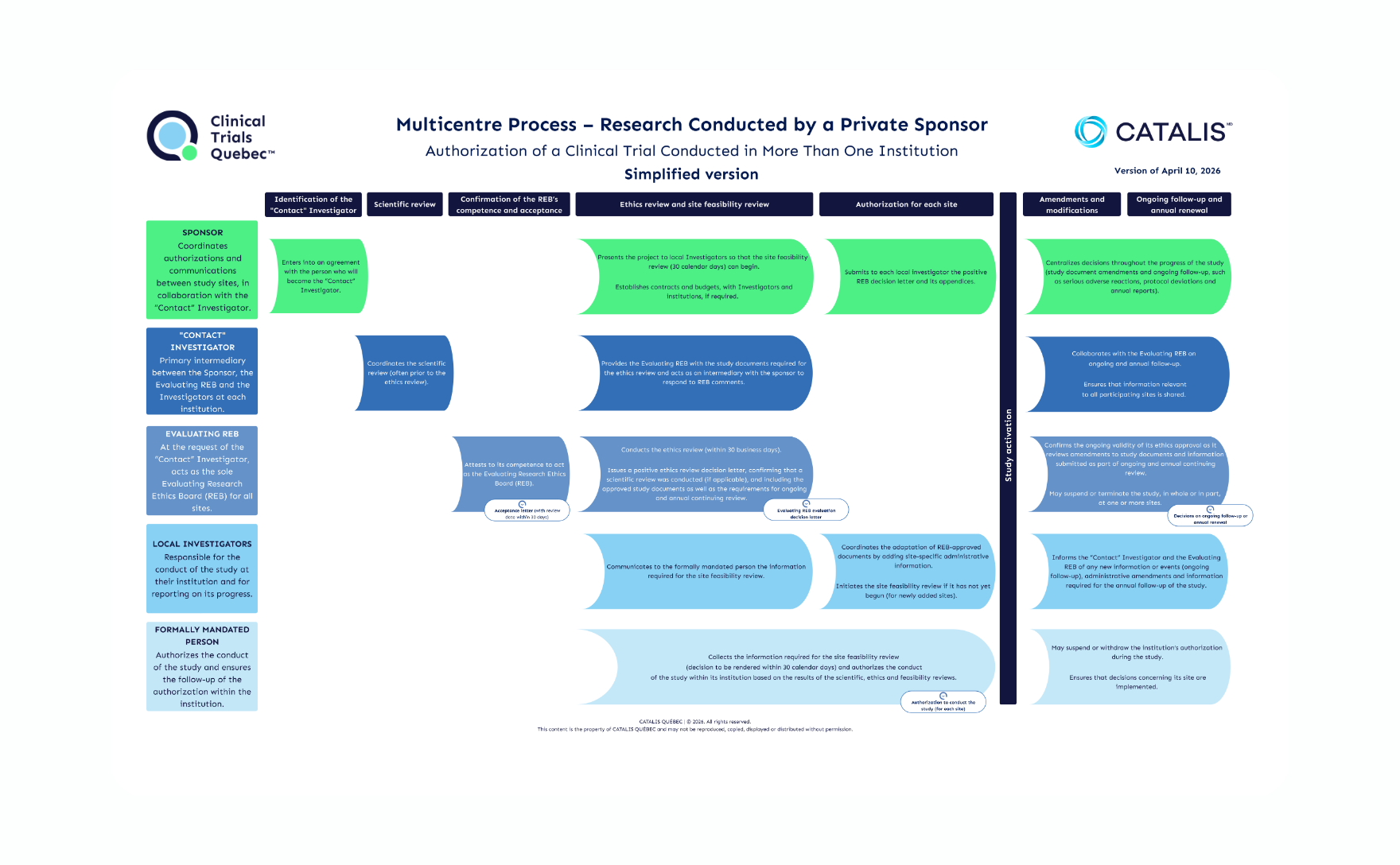


Quebec has implemented a multicentre authorization mechanism in clinical research that simplifies and streamlines the ethical review of projects conducted across more than one institution within the health and social services network. However, understanding and navigating this process can be a real challenge.
In this context, CATALIS Quebec, at the request of pharmaceutical companies within its Network of Partners, has developed two clear and complementary visual representations of the multicentre authorization process:
Overseen by the ministère de la Santé et des Services sociaux – MSSS (Québec Ministry of Health and Social Services), this process now represents a major strategic lever for sponsors seeking to efficiently deploy their clinical studies in Quebec.
Explore the multicentre processAt the heart of the multicentre mechanism lies a key principle: a single ethical review for the entire project.
In practice, a designated Research Ethics Board (REB) acts as the reviewing REB and conducts the main assessment of the project. This evaluation is then recognized by all participating institutions, eliminating the need to repeat the process at each site.
This harmonized approach helps avoid duplication of ethical reviews, significantly reduces approval timelines, and alleviate the administrative burden for all stakeholders.
Beyond simplifying processes, harmonized multicentre authorization promotes stronger alignment among key stakeholders: sponsors, ethics committees, healthcare institutions, and local authorities.
This enhanced coordination helps to:
In a highly competitive global environment, the ability to rapidly initiate clinical trials is a decisive factor.
Thanks to harmonized multicentre authorization, Quebec positions itself as a destination of choice for clinical research by offering efficient and standardized processes, recognized expertise, and an environment conducive to innovation.
Harmonized multicentre authorization represents far more than a regulatory mechanism—it is a true accelerator for clinical research projects, serving sponsors, research teams, and ultimately, patients.
Discover what makes Quebec a leader in clinical research
Follow the latest news from CATALIS and Clinical Trials Quebec

